Join Us Contact Us


    Declare ye among the nations, and publish, and set up
        a standard;  publish, and conceal not

Jeremiah 50:2

The Ancient Western Code: the Seven Noahide Laws, moral touchstones
for all eternity

One Father created us all. He Who lovingly grants us life and free will also blesses us with the gift of guiding law. Every person of every nation lives connected to the First Covenant.

What is moral? What is righteous? Not just refraining from committing crimes - actions that God Himself calls criminal, all the Seven Laws crimes - but doing the opposite of what the Noahide laws forbid.

Here are the Seven Noahide prohibitions, below, with their moral opposites:

  • Not just avoiding murder, but saving a human life in danger.

  • Not just avoiding stealing, but giving charitably.

  • Not just avoiding injustice, but striving for justice.

  • Not just avoiding sexual immorality, but creating and maintaining an exemplary family life.

  • Not just refraining from inflicting unnecessary pain on the animals that man eats but ensuring their decent treatment.

  • Not just avoiding sacrilege, or defaming God, but positively glorifying Him in the eyes of others, to lead them to do the same.

  • Not just avoiding gross idolatry (in Hebrew, gilulim, "abominable idolatry"), or cruel, repulsive acts that no god worth worshipping would ever sanction, but positively serving God, sanctifying Him in the eyes of others, leadinging them to do the same.


In the Bible, the People of Israel (Israel, "to struggle with God") are called to live by the Covenant of Sinai, including the Ten Commandments and the entire Law of Sinai, the Torah (Torah, the "Guidance" or "Teaching").

See Israel, Not the Point, Just the Instrument

The vast majority of humankind, Noahides or non-Jews, are blessed with an older covenant, older even than Abraham and Moses, which applies to everybody, including Israel.

And you shall seek Me, and find Me, when you
shall search for Me with all your heart

Jeremiah 29:13

Do you remember Noah and the Flood in the Bible? Remember when the Flood ends, and the rainbow after the Flood? That's where the Bible first refers to "covenant."

In the Book of Genesis, Chapter Nine, the Bible brings up the First Covenant - the word "covenant" comes up seven times in one short passage. It's the covenant that God makes and formalizes after the legendary Flood, at the beginning of the human race's story, between God and "all the Earth." That's the Noahide Covenant.

The rainbow, Genesis teaches, is the eternal symbol of that covenant, the Universal Covenant.

How is Rainbow Covenant received among "the experts," such as Jewish religious scholars?


The Rainbow Covenant consists of seven holy commandments: "connections" with God. From the beginning, from Adam and Eve, Noah and the descendants of Noah through Abraham, Isaac and Jacob, through Moses, through the Biblical prophets and kings and priests of Israel, and from the People of Israel of every generation, the People of Israel have kept this knowledge alive.

Commandment, in Hebrew, comes from the root "connection." By fulfilling a commandment, human beings connect with our Maker.

These seven commandments are the heart of the Bible. They are the bedrock of civilization.

The Seven Commandments don't include the entire Law that God commanded Israel at Sinai. They don't include the people of Israel's unique religious "statutes," such as the Torah statutes regarding not eating pork, or Israel's special religious rituals, because those statutes directly command only Israel. They are not legally binding on all humankind. Unlike the Seven Laws, they don't apply to every human being at all times, in all places, forever.

For more on this distinction, and on the nature of the Torah's "righteous statutes" (see Deuteronomy 4:5), see the series on Torah statutes in our newsletter, Covenant Connection.

The Seven Noahide Laws do include, in outline, every single precept, law and commandment in the Bible that's logical - that could be derived from intelligence and common-sense even in the absence of Divine Revelation. That is, all the Noahide laws make sense on their own; they are, at least once you've learned them, obvious; they would make sense and appeal to human logic even if they had never been revealed at Sinai. They are different from the Torah's statutes in that, unlike Israel's national laws against eating pork, say, or keeping the seventh day of the week - the Sabbath - holy, human beings have the ability to recognize them as true even if the Bible didn't say so.

Alone of all the other nations of the earth, because they cherished the Seven Commandments as God's Way, only the People of Israel kept this ancient body of knowledge intact - by saving it as part of the Torah, the Biblical Tradition.

I will delight myself in Thy statutes: I will not forget Thy Word. Psalms 119:16

We state the Seven Commandments below as they have come down to us, phrased in negative terms - as "thou shall nots." We need to see them for what they really are, however. They are positive principles. They remove the darkness from life and replace it with light, to show us, for sure, if there were ever any question, what is sacred, sane, true and wise and godly. In essence, these Seven Laws give us the secret of existence.

Go to our newsletters, Covenant Connection, (particularly, volume 3, issue 4, Saints and Sinners, the July 2008 issue, and then issue 4, Revolutionary Doctrine, the September issue) and to our book, Rainbow Covenant, to get more than the summary, cursory description below of this remarkably beautiful body of wisdom. Also, go to the newsletter and the book to get a fuller sense of the real meaning and context of all this knowledge.

Taking the Seven Noahide Laws from the seemingly narrowest and most mundane to the broadest and most spiritual — the order in which they are discussed in Rainbow Covenant — they are:

1. Dietary Morality

This sounds like a law for cavemen, but human beings are the elect of God's creation. He has given us, mere homo sapiens (ordinary human beings, rather than super-beings, or aliens), dominion over all earthly life. He requires us to act accordingly, with respect for the life that He has put under our control as well as respect for ourselves as His servants:

You shall not eat flesh that was cut or torn from a living creature, from any bird or mammal.

Every creature eats. This eternal, universal principle requires us, God's planetary stewards, to treat the animals that we eat (and ultimately, every creature subject to human control) with self-control, self-respect, and a decent regard for the life that God has made.

He Who grants us dominion despises cruelty, indecency and savagery. He commands us all to conduct ourselves better than mere animals - piggish animals. He didn't create us in His image and grant us mastery to waste His Earth's resources or mistreat our fellow creatures.

To treat animals cruelly is wrong. To eat, as animals eat, disgusting things, even when we don't absolutely need to, makes us disgusting. To combine the two wrongs, and to be so heedless of a fellow creature's suffering as to eat its flesh before it's even dead, violates God's Law.

2. Against Larceny

Every person stands on an equal footing before the Lord. The person who has the best claim and greatest right to a thing is normally the person who already owns it. HaShem, God, is the ultimate Owner of all Creation's riches (which He permits us to use and enjoy for His purposes).

Larceny - every kind of unrighteous or dishonest taking, including theft, fraud, robbery, receiving stolen goods, rape, kidnapping, assault and battery, defamation, counterfeiting, oppression of debtors or employees, and commercial crimes of every sort — defiles the Earth, according to the Bible. And we can see that for ourselves in our own daily lives.

3. Against Sexual Immorality

Not all love is holy. God commands us to refrain from certain acts of perverted love and self-destructive sexuality. Just as sex offers us a means to make ourselves more fully human, it can also reduce us below (!) the level of the animals. (Animals have instincts. Humans are ruled by their eyes and ears and hearts and minds - and, without moral discipline or knowledge, that can make us extraordinarily perverse.

4. Against Murder

All souls are God's. Every human being exists in the "image" of God and is a child of God. To murder - wrongfully kill - another human being is a horrible and foul crime. It literally defiles the Earth (as the Bible teaches, and as we can also see for ourselves just by following the news).

One should study this holy principle to get at the full implications of matters including suicide, self-defense and the defense of others, "mercy killing" and physician-assisted suicide, war, capital punishment and abortion. (Abortion, by the way, isn't murder. But we can't cover the whole subject here. People need to be aware of the Torah's "40-Day Rule" -- 40-days past conception, the fetus must not be deliberately aborted except to save the mother's life.)

5. Against Lawlessness

Mankind is divinely obligated to act against injustice so far as possible. Judgment is not something that one can simply leave to Heaven: in matters of goodness and justice, human beings are God's agents on Earth. To fail to act against injustice, when one has the opportunity to act, is wrong - and sometimes criminal.

This principle functions as a positive principle - not merely a negative injunction, prohibiting injustice — to establish a fair, just system of police and laws and courts, and to create and enforce regulations that ensure justice and fairness in commerce and in general.

6. Against Sacrilege

This sacred principle touches on every Noahide principle. God grants us not only the power to honor Him but also to dishonor Him - here on Earth, before one's fellow men and women. He grants us free will to choose our way for ourselves. He forbids us to dishonor Him.

However we think of God - whether as "Hairy Thunderer" or "Cosmic Muffin," as distant spirit or immanent and physical, as a Being with associates or partners or as absolutely and uniquely One - we need to remember this, at least: that the things that we do in His Name reflect back on Him.

7. Laws against Idolatry

Every Divine principle comes back to this principle, and makes the same all-important point. God is good and He loves goodness. If you try to worship Him by doing evil you are not worshipping Him - you are serving something or someone other than God.

This law and the law against sacrilege work together - like the legs of a person walking. The ultimate point of both of them is to raise up mankind to spiritual and moral adulthood, so that knowledge of God fills the earth as the waters cover the seas and, as the prophet says, God pours out His spirit upon "all flesh" (Joel 3:1).

* *

These are the Seven Universal Moral Principles - in outline. But the outline is just the beginning of knowledge: these ancient, wise and holy laws represent a unified system for all humanity. . . .

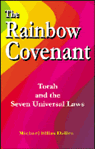
For deeper insight, explore the website, consider getting what some call "by far the best book on the subject" (from the reviews on Amazon.com) [click on the icon, right], and go to About Us, to learn more about this all-important cause - and how you can help!


And God spoke unto Noah, and to Noah's children
  with him, saying, 'And as for Me, behold, I establish My covenant with you, and with your seed after you.'

  Genesis 9 : 8-9


Home | About Us | Articles | Newsletter | Seven Laws | FAQs | Community | Contact Us | Contribute

© Copyright 2005-2012
The First Covenant Foundation

website hosted by: Green Country Small Business Solutions, LLC